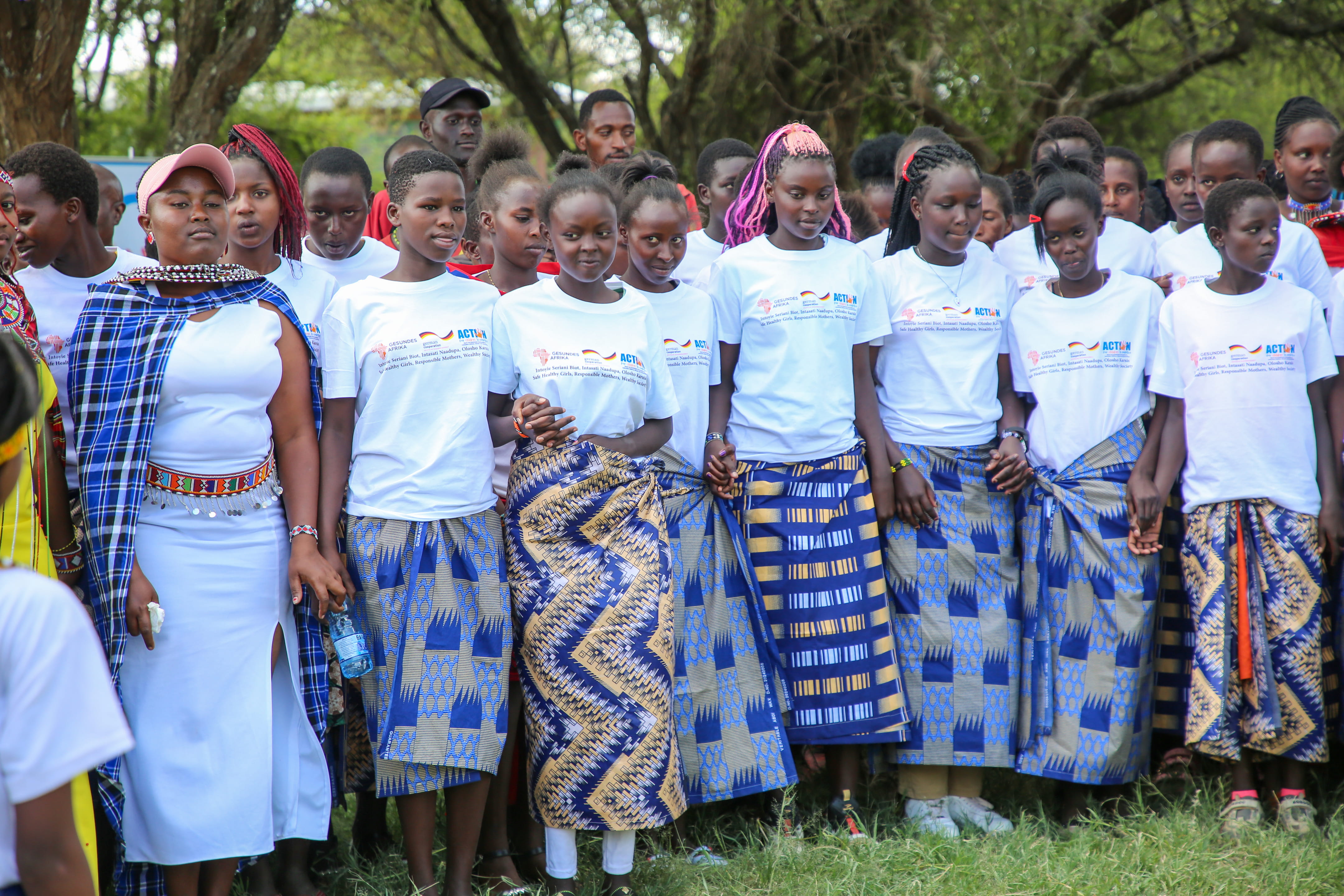
CONSULTANCY FOR THE ENDLINE EVALUATION OF THE WEZESHA WASICHANA PROJECT
Action for Children in Conflict (AfCiC) is seeking to engage an independent consultant or consultancy firm to undertake an endline evaluation of the Wezesha Wasichana Project implemented in Laikipia North, Kenya.
Terms of Reference
CONSULTANCY FOR THE ENDLINE EVALUATION OF THE
WEZESHA WASICHANA PROJECT
1. BACKGROUND AND PURPOSE
Action for Children in Conflict (AfCiC) is seeking to engage an independent consultant or consultancy
firm to undertake an endline evaluation of the Wezesha Wasichana Project implemented in Laikipia
North, Kenya.
The Wezesha Wasichana Project seeks to contribute to the reduction of Female Genital
Mutilation/Cutting (FGM/C), child marriage, adolescent pregnancy and Gender-Based Violence
(GBV), while strengthening the protection, participation and empowerment of girls.
The project has implemented several interventions, including school health clubs, intergenerational
dialogues, Alternative Rites of Passage (ARP), rescue and referral services, and strengthening of child
protection working groups. It has also supported capacity building for teachers, community leaders
and other stakeholders who influence decisions affecting girls' rights and wellbeing.
As the project approaches completion, AfCiC intends to commission an independent endline
evaluation to assess its performance, achievements, outcomes and sustainability. The evaluation will
compare endline findings against baseline data, where indicators and measurement approaches are
comparable, to establish the extent of change achieved during the project implementation period.
The findings will inform AfCiC, its partners and relevant stakeholders on programme effectiveness,
lessons learnt, remaining protection gaps and recommendations for future programming and advocacy
initiatives.
2. OBJECTIVES OF THE EVALUATION
2.1 General Objective
To assess the effectiveness, contribution to observed changes and sustainability of the Wezesha
Wasichana Project by examining changes in knowledge, attitudes, practices, behaviours and
institutional capacity from baseline to endline.
2.2 Specific Objectives
The evaluation will seek to:
1. Measure changes in knowledge, attitudes and practices: Compare baseline and endline
findings on FGM/C, child marriage, adolescent pregnancy, GBV and related child protection
concerns.
2. Assess the effectiveness of key interventions: Examine how school health clubs,
intergenerational dialogues and Alternative Rites of Passage have contributed to girls'
empowerment, agency, social norm change and behaviour change.
3. Evaluate protection and referral mechanisms: Assess the functionality and effectiveness of
child protection working groups, rescue and referral pathways, and coordination among
relevant service providers.
4. Assess stakeholder capacity: Examine changes in the knowledge, skills and capacity of
teachers, community leaders, local administrators, community health promoters and other
relevant stakeholders in protecting girls.
5. Examine the project's contribution to prevention: Assess changes in community acceptance
of harmful practices and review available evidence on prevention efforts and reported cases.
6. Assess sustainability: Examine local ownership, institutional capacity, functionality of
established structures and the likelihood of continued implementation of project-supported
interventions beyond the project period.
7. Document lessons and good practices: Identify successful approaches, implementation
challenges and practical recommendations for strengthening FGM/C abandonment, girls'
empowerment and child protection programming.
3. KEY EVALUATION QUESTIONS
The evaluation will be guided by the following questions:
3.1 Relevance, Reach and Inclusion
-To what extent did project interventions address the needs and priorities of girls at greatest
risk?
-Which groups of girls were reached or potentially excluded, including out-of-school girls, girls
with disabilities and those in hard-to-reach locations?
- How effective were the project's targeting and participation criteria?
3.2 Effectiveness and Girls' Empowerment
-What changes have occurred in knowledge, attitudes, perceived social expectations and
reported practices relating to FGM/C, child marriage, adolescent pregnancy and GBV?
-To what extent have project activities strengthened girls' confidence, participation in decision-
making and ability to identify and seek support for protection concerns?
- Which interventions contributed most significantly to observed changes?
-Were there any unintended outcomes or implementation barriers?
3.3 Protection, Capacity and Coordination
-Are girls and caregivers aware of available protection services and able to access support
safely?
-How effective, timely and accessible are existing rescue, referral and follow-up mechanisms?
-To what extent have schools, child protection working groups, local authorities, health
facilities and other service providers improved coordination?
-How effectively are trained stakeholders applying their knowledge and skills?
3.4 Contribution and Monitoring Quality
-To what extent have project indicators changed from baseline and progressed towards the
intended targets?
-What evidence supports the project's contribution to observed changes?
-How reliable and comprehensive are the project's monitoring records, indicator definitions and
reporting systems?
3.5 Efficiency
-Were project activities implemented within the planned timelines?
-Were available financial, human and material resources utilized efficiently in relation to
program reach and quality, where relevant data are available?
3.6 Participation and Accountability
-To what extent did girls and community members participate in project planning,
implementation and decision-making?
-Were feedback and complaints mechanisms accessible, safe and understood by beneficiaries?
- How effectively did AfCiC respond to feedback received?
3.7 Sustainability and Learning
- Which interventions, school clubs, community structures and referral mechanisms are likely to
continue beyond the project period?
- What local resources, leadership and institutional commitments are available to sustain the
gains?
- What lessons should inform future programming?
4. SCOPE OF THE ASSIGNMENT
The evaluation will cover the entire project implementation period, from baseline to project close, and
will focus on communities, schools and other implementation sites where the Wezesha Wasichana
Project was implemented in Laikipia North.
The consultant will be expected to:
1. Review relevant project documentation, including the project proposal, theory of change,
results framework, baseline report, monitoring and evaluation tools, progress reports, training
records, attendance registers, working-group records, aggregated referral data, feedback
records and relevant expenditure summaries.
2. Assess the implementation and performance of the project's key interventions.
3. Engage relevant project stakeholders, including:
- Adolescent girls, both in and out of school.
- Parents and caregivers.
- Teachers and school administrators.
- Community and faith leaders.
- Community health promoters.
- Gender defenders and child protection actors.
- Local administrators and government representatives.
-Child protection working groups.
-Children's Services Officers and other relevant service providers.
-AfCiC programme staff and project management.
4. Where feasible and safe, include eligible community members who did not directly participate
in project activities to provide additional perspectives on community-level changes.
5. Assess the extent to which project interventions have contributed to the intended outcomes and
identify remaining gaps and opportunities for improvement.
The final scope, implementation sites, evaluation period and priority respondent groups will be
confirmed with AfCiC during the inception phase.
5. METHODOLOGY AND APPROACH
The consultant is expected to propose a robust, participatory and mixed-methods evaluation approach
that combines quantitative and qualitative data collection and analysis.
The proposed methodology should include, but not be limited to, the following:
5.1 Evaluation Design and Baseline Comparability
The evaluation should use a mixed-methods approach to assess changes in project outcomes and
provide an understanding of the factors contributing to those changes.
The consultant will:
-Map priority indicators against their baseline values, targets, data sources and definitions.
- Ensure consistency between baseline and endline measurement approaches wherever possible.
-Compare indicators using similar questions, response options, recall periods, denominators and
geographic coverage.
- Document any differences in measurement approaches and clearly distinguish comparable
indicators from findings that can only be described at endline.
5.2 Sampling and Data Collection
The consultant will propose and justify an appropriate sampling strategy, including sample size,
sampling frame, respondent selection and non-response management.
The approach shoul :
- Use probability sampling where an appropriate sampling frame exists.
- Ensure representation of relevant age groups, locations, schooling status and disability groups,
where feasible and safe.
-Include both quantitative surveys and qualitative approaches such as Key Informant Interviews
(KIIs), Focus Group Discussions (FGDs) and stakeholder consultations.
-Use appropriately trained field researchers and age-appropriate data collection tools.
-Pilot and refine data collection instruments before full implementation.
-Ensure interviews and surveys are conducted in safe, private and accessible settings.
5.3 Data Analysis and Interpretation
The consultant will analyse quantitative and qualitative data to establish the extent of change and
explain the factors influencing project outcomes.
The analysis should:
- Present baseline, endline and target values for comparable indicators.
-Calculate percentage-point changes where applicable.
-Provide appropriate statistical analysis and confidence intervals where supported by the
sampling design.
-Disaggregate findings by age, sex, disability, schooling status, geographical location and level
of project exposure, where relevant, feasible and safe.
-Triangulate quantitative findings with qualitative and administrative evidence.
-Examine alternative explanations for observed changes and clearly state the limitations of
attributing outcomes to the project.
-Distinguish reported cases and referral trends from actual prevalence, taking into consideration
possible underreporting and changes in reporting access.
5.4 Quality Assurance
The consultant will be responsible for ensuring the quality and reliability of the evaluation process
through:
- Adequate training and supervision of data collection teams.
- Daily checks for data completeness, accuracy and consistency.
- Documentation of missing data, fieldwork deviations and limitations.
-Secure storage and management of collected information.
-Maintenance of reproducible analysis files.
- Presentation and validation of preliminary findings with AfCiC and selected stakeholders
using anonymised information.
6. SAFEGUARDING, ETHICAL CONSIDERATIONS AND DATA PROTECTION
Given the sensitive nature of the evaluation and its focus on children and adolescent girls, the
consultant must demonstrate strong safeguarding, ethical research and data protection practices
throughout the assignment.
The consultant will be required to:
1. Agree on a safeguarding and disclosure management protocol with AfCiC's safeguarding focal
person before commencing fieldwork.
2. Obtain all applicable ethical and administrative approvals before data collection begins.
3. Ensure informed adult consent and age-appropriate assent and parent or guardian consent for
minors, in accordance with the approved ethical protocol and applicable requirements.
4. Explain the purpose of the evaluation, voluntary participation, the right to withdraw or skip
questions, and the limits of confidentiality to all respondents.
5. Ensure that field researchers are adequately trained in child safeguarding, confidentiality,
informed consent and survivor-centred approaches.
6. Use safe, private and age-appropriate data collection methods. Group discussions should focus
on general community norms and available services rather than soliciting personal accounts of
harm.
7. Ensure that any individual questions concerning lived experiences of abuse or harm are
covered by specific ethical approval and an appropriate safety protocol.
8. Verify referral contacts and escalation procedures and ensure that disclosures and safeguarding
concerns are handled through agreed child protection and survivor-centred referral pathways.
9. Collect only essential information and ensure that consent and contact information are stored
separately from research responses.
10. Protect collected information through restricted access, encryption, secure transfer and
appropriate data retention and deletion procedures.
11. Ensure that reports, presentations and datasets do not expose the identities of children,
survivors or other vulnerable respondents.
The consultant must comply with the Kenya Data Protection Act, 2019, applicable child protection
legislation and relevant ethical research standards.
7. DURATION AND DELIVERABLES
The assignment is expected to take approximately 30 working days, including 10 working days
dedicated to training, piloting and fieldwork in Laikipia North.
The specific calendar dates, review periods and approval timelines will be agreed upon between
AfCiC and the selected consultant at contracting. Fieldwork will commence only after approval of the
inception package and receipt of all applicable approvals.
The expected deliverables are as follows:
Phase Working
Days Expected Deliverables
Inception 5
Inception report containing the evaluation matrix, baseline indicator mapping,
sampling and analysis plan, draft data collection tools, fieldwork schedule and
safeguarding protocol.
Fieldwork 10 Training and pilot summary, final data collection tools, and fieldwork
completion report indicating respondent coverage and any deviations.
Analysis and
Draft Report 7
Draft evaluation report, baseline-to-endline indicator comparison table, key
findings and actionable recommendations.
Validation and
Revision 4
Stakeholder validation presentation, documented feedback and a revised report
addressing the feedback received.
Final
Submission 4
Final evaluation report, presentation, de-identified dataset, codebook, analysis
files and final data collection tools.
Total 30
All deliverables must be submitted in editable electronic formats. The final report should be submitted
in Microsoft Word and PDF formats.
8. MANAGEMENT AND REPORTING ARRANGEMENTS
The consultant will report directly to the AfCiC Director for Programmes and Operations, who will
provide overall oversight and coordinate access to relevant project information, implementation sites
and stakeholders.
The Project Manager and relevant programme staff will support the consultant in accessing project
records, verifying monitoring data and coordinating fieldwork.
AfCiC's safeguarding focal person will provide guidance on safeguarding protocols, ethical
considerations and referral procedures.
The consultant will retain responsibility for the independence, objectivity, quality and integrity of the
evaluation findings, conclusions and recommendations.
The contract will specify the assignment dates, payment milestones, fieldwork logistics,
confidentiality requirements, data ownership and other contractual obligations.
9. METHOD OF APPLICATION
Interested and qualified individual consultants or consultancy firms are invited to submit their
applications for consideration.
Applicants should submit the following documents:
1. Technical Proposal outlining their understanding of the assignment, proposed evaluation
methodology, sampling strategy, data collection and analysis approaches, quality assurance
measures and proposed work plan.
2. Financial Proposal providing a detailed and itemised budget for undertaking the assignment.
The budget should include professional fees, fieldwork expenses, transport, accommodation,
data collection, analysis and any applicable taxes.
3. Updated Curriculum Vitae (CVs) of the lead consultant and proposed team members, clearly
highlighting relevant qualifications and experience.
4. Relevant Experience and References: Evidence of at least two similar evaluation
assignments undertaken, including brief descriptions of the assignments and contact details of
referees. Copies of relevant reports or samples of previous evaluation work may also be
included where available and permitted.
5. Academic and Professional Certificates demonstrating the qualifications and expertise of the
proposed consultant or team.
6. Registration Documents: For consultancy firms, include a valid certificate of registration or
incorporation and relevant statutory documentation.
7. Availability Statement: Confirmation of availability to undertake the assignment within the
proposed timeframe.
Submission Procedure
All application documents should be submitted in a sealed envelope clearly marked:
"CONSULTANCY FOR THE ENDLINE EVALUATION OF THE WEZESHA WASICHANA
PROJECT"
Applications must be physically delivered and deposited at the Action for Children in Conflict
(AfCiC) offices in Thika, Kenya, on or before 10th October 2026 COB.
Late submissions and applications that do not meet the stated requirements may not be considered.
Only shortlisted applicants will be contacted. AfCiC reserves the right to accept or reject any
application in accordance with its procurement procedures.
10. CONSULTANT QUALIFICATIONS AND EXPERIENCE
The assignment is open to qualified individual consultants or consultancy firms with demonstrated
experience in program evaluations, research and child protection programming.
The ideal consultant or team should possess the following qualifications and competencies:
10.1 Academic Qualifications
-A postgraduate qualification in Monitoring and Evaluation, Social Sciences, Development
Studies, Gender Studies, Public Health, Research Methods or a related field, or equivalent
relevant professional experience.
-Additional training in child protection, gender and development, safeguarding or research
ethics will be an added advantage.
10.2 Relevant Professional Experience
- Demonstrated experience in conducting independent endline evaluations, baseline studies,
impact assessments or similar research assignments.
-Proven experience in mixed-methods research, quantitative and qualitative data collection,
analysis and reporting.
-Demonstrated experience in baseline-to-endline comparisons and outcome measurement.
- Relevant experience in child protection, FGM/C prevention, child marriage, GBV prevention,
adolescent health or girls' empowerment programming.
-Experience working with communities, schools, government institutions and development
partners.
10.3 Technical Competencies
- Strong knowledge of evaluation methodologies, sampling techniques, data analysis and
interpretation.
-Ability to develop appropriate research tools and undertake rigorous data quality assurance.
-Demonstrated understanding of safeguarding and ethical research involving children and other
vulnerable groups.
- Familiarity with data collection and analysis software and tools.
- Excellent report writing, presentation and communication skills.
10.4 Other Requirements
-Ability to work within the agreed assignment timeframe and conduct fieldwork in Laikipia
North.
-Fluency in English and ability to work in relevant local languages.
-Strong interpersonal, facilitation and stakeholder engagement skills.
-Demonstrated independence, objectivity and professional integrity.
-Disclosure of any actual or potential conflict of interest.
AfCiC looks forward to receiving applications from qualified consultants and consultancy firms
committed to advancing girls' rights, protection and empowerment.
Download TOR her